


IGF-1 LR3

Price range: €48 through €371
 18 sold in last 6 hours
Buy IGF-1 LR3 online | IGF-1 LR3 for sale
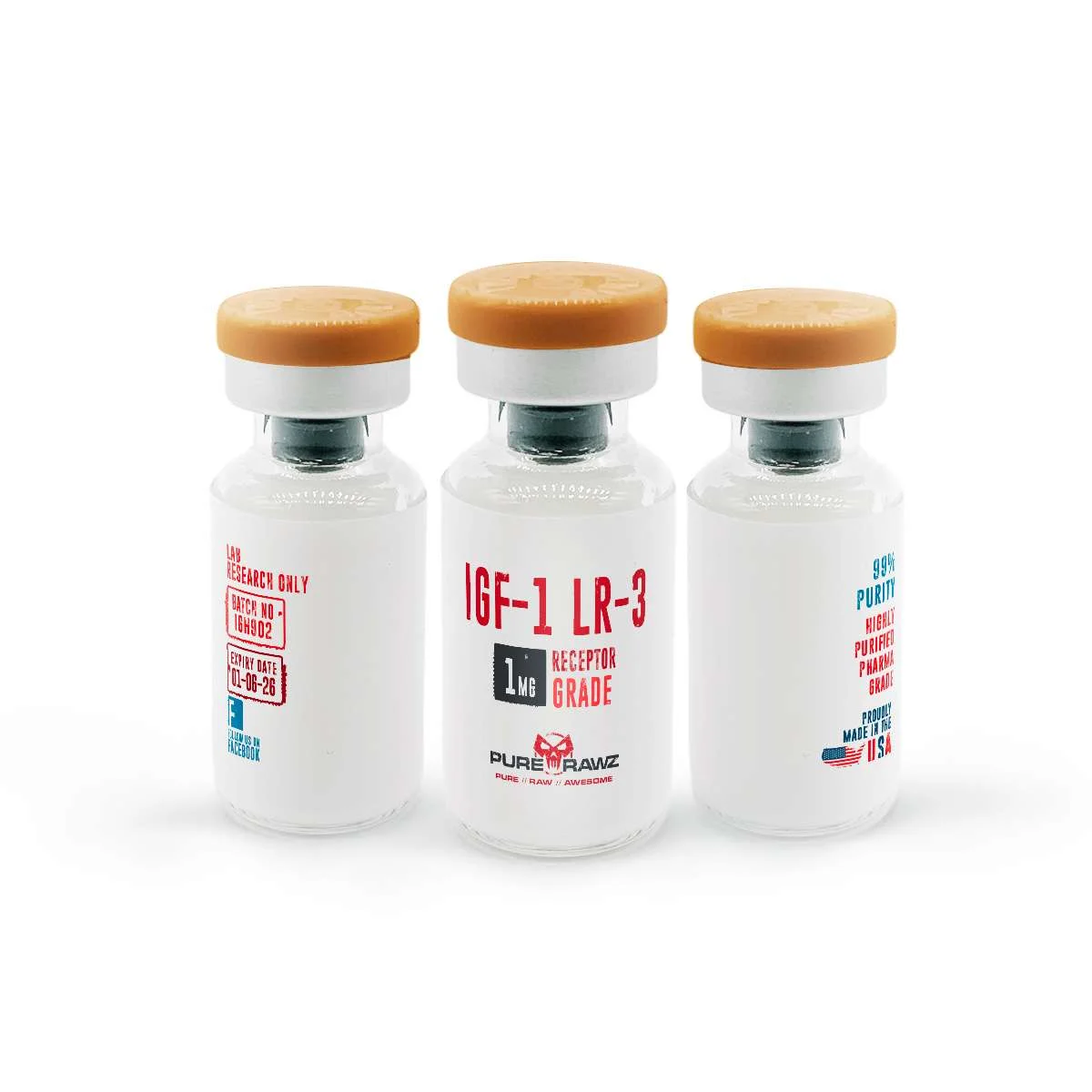
IGF-1 LR3 (Insulin-like Growth Factor-1 Long Arg3) is a synthetic, modified analog of endogenous IGF-1. This 83-amino-acid polypeptide features an arginine substitution for glutamic acid at position 3, plus an additional 13-amino-acid N-terminal extension (MFPAMPLLSLFVN).
These structural modifications collectively reduce its affinity for IGF-binding proteins (IGFBPs) and extend its functional half-life to approximately 20–30 hours in preclinical models, compared to 12–15 hours for native IGF-1.
IGF-1 LR3 is studied as an investigational compound in molecular biology and endocrinology research. Its structural design allows investigators to study sustained IGF-1 receptor engagement. In preclinical studies, the compound is being examined for its growth factor signaling, cellular proliferation, and metabolic pathway regulation.
Disclaimer:
The products sold by PureRawz are intended solely for laboratory and research purposes. They are not FDA-approved for human or animal consumption, and PureRawz does not sell these compounds for use in humans or animals. All compounds are strictly for use by qualified researchers in controlled, non-clinical laboratory environments in compliance with applicable regulations.
Chemical Properties
| Property | Description |
| Chemical Name (IUPAC) | Insulin-like Growth Factor-1 Long R3 |
| Synonyms | Long R3-IGF-1; Long Arg3-IGF-1; LR3-IGF-I; IGF-1 LR3 |
| CAS Number | 946870-92-4 |
| PubChem CID | 168009904 |
| Molecular Formula | C₄₀₀H₆₂₅N₁₁₁O₁₁₅S₉ |
| Molecular Weight | ~9,117.6 g/mol |
| Amino Acid Length | 83 amino acids |
| Structural Modification | Native IGF-1 sequence (70 amino acids) with a 13-amino-acid N-terminal extension and Arg substitution at position 3 |
| Appearance / Physical Form | White lyophilized powder |
| Solubility | Water soluble |
| Recommended Reconstitution | Sterile water or 0.1% acetic acid (laboratory use only) |
| Purity Specification | ≥99% (HPLC verified) |
| Lyophilized Storage Conditions | Store at −20°C in a dry, light-protected environment |
| Lyophilized Stability | Stable for ≥24 months under recommended storage conditions |
| Reconstituted Storage Conditions | Store at 2–8°C |
| Reconstituted Stability | Use within 4 weeks after reconstitution |
| Freeze–Thaw Recommendation | Avoid repeated freeze–thaw cycles |
| Biological Half-Life | Approximately 20–30 hours (preclinical data) |
| Classification | Research Use Only (RUO) |
| Regulatory / Sports Status | Prohibited by World Anti-Doping Agency under S2.2 — Peptide Hormones, Growth Factors, Related Substances and Mimetics |
| Competition Status | Banned both in-competition and out-of-competition by the World Anti-Doping Agency |
Proposed Working Mechanism of IGF-1 LR3
Proposed Working Mechanism of IGF-1 LR3 Preclinical studies indicate that IGF-1 LR3 works by binding to the IGF-1 receptor (IGF-1R), a transmembrane tyrosine kinase receptor. Upon receptor engagement in research models, IGF-1 LR3 activates two major downstream signaling cascades:
– PI3K/Akt/mTOR pathway — associated with cellular survival, protein synthesis, and anabolic signaling processes in experimental models.
– MAPK/ERK pathway — implicated in cellular proliferation and differentiation responses in preclinical systems.
The defining characteristic of IGF-1 LR3 is it markedly reduced binding affinity for IGF-binding proteins (IGFBPs).
In native IGF-1, IGFBPs regulate circulating availability and limit receptor interaction dynamics. The arginine substitution at position 3 and the N-terminal extension collectively reduce IGFBP affinity by approximately 100–1,000-fold in preclinical binding assays.
Possible Research Applications of IGF-1 LR3
-
Protein Synthesis Signaling Research
In vitro findings suggest IGF-1 LR3 may influence myoblast proliferation and differentiation.
-
Metabolic Pathway Investigation
Experimental data have shown that IGF-1 LR3 may potentially be involved in glucose uptake regulation through GLUT4 translocation mechanisms.
-
Bone and Cartilage Research
Preclinical in vitro evidence suggests IGF-1 LR3 may affect osteoblast and chondrocyte activity, with relevance to skeletal growth factor signaling research.
-
Cellular Proliferation and Survival Studies
In vitro observations indicate IGF-1 LR3 may engage anti-apoptotic signaling pathways through Akt phosphorylation.
-
Neuroscience and Neuroprotection Research
Preliminary experimental findings suggest IGF-1 LR3 may interact with IGF-1 receptors expressed in neural tissue models, with investigational relevance to neuronal signaling and growth factor responsiveness research.
Risk and Handling
IGF-1 LR3 is a peptide compound classified for laboratory research use only and must be handled exclusively by qualified researchers within a controlled laboratory environment.
- Standard laboratory personal protective equipment (PPE), including nitrile gloves, safety glasses, and a lab coat, is recommended during handling and reconstitution procedures.
- The compound should be stored lyophilized (if supplied as powder) at –20°C, protected from light and moisture.
- Once reconstituted in an appropriate sterile diluent for experimental use, storage at 4°C is indicated for short-term use, with re-freezing avoided to preserve peptide integrity.
- Repeated freeze-thaw cycles may degrade compound stability and compromise research data validity.
- Researchers are advised to consult the Safety Data Sheet (SDS) before handling. This compound is for research use only. It should be handled by qualified researchers in a controlled laboratory environment in accordance with all applicable institutional and regulatory guidelines.
Toxicity and Data Limitations
- Comprehensive toxicological profiling for IGF-1 LR3 in humans is not established in the peer-reviewed literature.
Regulatory Status
- IGF-1 LR3 is not approved by the FDA for human or veterinary use. It is supplied exclusively as a Research Use Only (RUO) material.
WADA Status: PROHIBITED
- IGF-1 LR3 is prohibited under WADA Prohibited. Peptide Hormones, Growth Factors, Related Substances and Mimetics, banned at all times, in- and out-of-competition.
Disposal
- All unused compounds must be disposed of in compliance with applicable institutional and regulatory guidelines for investigational peptide materials.
Why Buy IGF-1 LR3 from PureRawz
Each batch of IGF-1 LR3 supplied by PureRawz undergoes independent third-party laboratory testing, with batch-specific Certificate of Analysis (COA) documentation available for researcher verification
before experimental use.
– Independent third-party laboratory testing per batch
– COA confirming compound identity and purity per lot
– Purity verified by HPLC to ≥99%
– Molecular identity confirmed against CAS 946870-92-4
– PureRawz does not self-certify — all quality verification is
conducted by accredited independent laboratories
Researchers can access batch-specific COA documentation to validate compound identity, purity, and concentration before research use.
FAQs
What distinguishes IGF-1 LR3 from native IGF-1 in research applications?
IGF-1 LR3 is a modified IGF-1 analog engineered with an arginine substitution at position 3 and a 13-amino-acid N-terminal extension. These modifications reduce IGF-binding protein affinity by approximately 100–1,000-fold in preclinical binding assays and extend functional half-life to approximately 20–30 hours, supporting extended signaling analysis in laboratory settings.
Why is IGF-1 LR3 commonly used in receptor signaling research?
IGF-1 LR3 is utilized to investigate sustained IGF-1 receptor (IGF-1R) activation and downstream signaling pathways — specifically PI3K/Akt/ mTOR and MAPK/ERK — in controlled preclinical systems. Its reduced IGFBP affinity allows more free ligand to engage receptors directly, enabling extended pathway observation without the binding-protein interference encountered with native IGF-1.
What areas of preclinical investigation currently involve IGF-1 LR3?
Current investigational applications in preclinical research include skeletal muscle biology, metabolic signaling, regenerative research, neurobiology, and cellular growth pathway analysis. IGF-1 LR3 is particularly studied in myoblast proliferation models, osteoblast and chondrocyte signaling, and glucose uptake regulation via GLUT4 translocation in in vitro systems.
How does reduced IGF-binding protein affinity affect experimental outcomes?
Reduced IGFBP interaction increases free ligand availability in experimental systems, enabling prolonged receptor engagement and extended downstream signaling evaluation. In preclinical binding assays, IGF-1 LR3 demonstrates approximately 100–1,000-fold lower IGFBP affinity than native IGF-1, resulting in greater receptor-level exposure per unit of compound administered.
What considerations are important when designing experiments with IGF-1 LR3?
Research protocols should account for receptor sensitivity, IGF-1R expression levels in the model system, exposure duration, signaling saturation thresholds, dose-response behavior, and peptide stability under laboratory conditions. The extended half-life of approximately 20–30 hours in preclinical models should be factored into the washout period design between experimental runs.
How should IGF-1 LR3 be stored and handled for laboratory integrity?
Lyophilized IGF-1 LR3 should be stored at −20°C in dry, light-protected conditions. Following reconstitution, material should be maintained at 2–8°C and used within four weeks. Repeated
freeze-thaw cycles should be avoided; aliquoting prior to freezing preserves peptide integrity and minimizes degradation-related variability in research data.
Is IGF-1 LR3 approved for therapeutic or clinical applications?
No. IGF-1 LR3 is an investigational research material and is not approved for human use, veterinary use, or clinical application by any regulatory authority, including the FDA. It is supplied exclusively as a Research Use Only (RUO) compound for use by qualified researchers in controlled, non-clinical laboratory environments.
Why is IGF-1 signaling considered significant in biomedical research?
The IGF-1 signaling axis is widely studied for its involvement in cellular proliferation, metabolic regulation, tissue growth, and intracellular signaling mechanisms in preclinical research models. IGF-1R activation initiates PI3K/Akt/mTOR and MAPK/ERK cascades implicated in anabolic processes, making IGF-1 axis compounds valuable tools for investigating growth factor biology in controlled
experimental systems.
| Form | Media Grade, Receptor Grade, Receptor Grade Kit, Receptor Grade Nasal Spray, Media Grade Nasal Spray |
|---|---|
| Strength | 1mg, 2 x 0.1mg(100mcg) Vials, 200mcg/0.2mg, 100mcg x 10 Vials=1mg, 10mcg per spray/1mg |







Reviews
There are no reviews yet.