

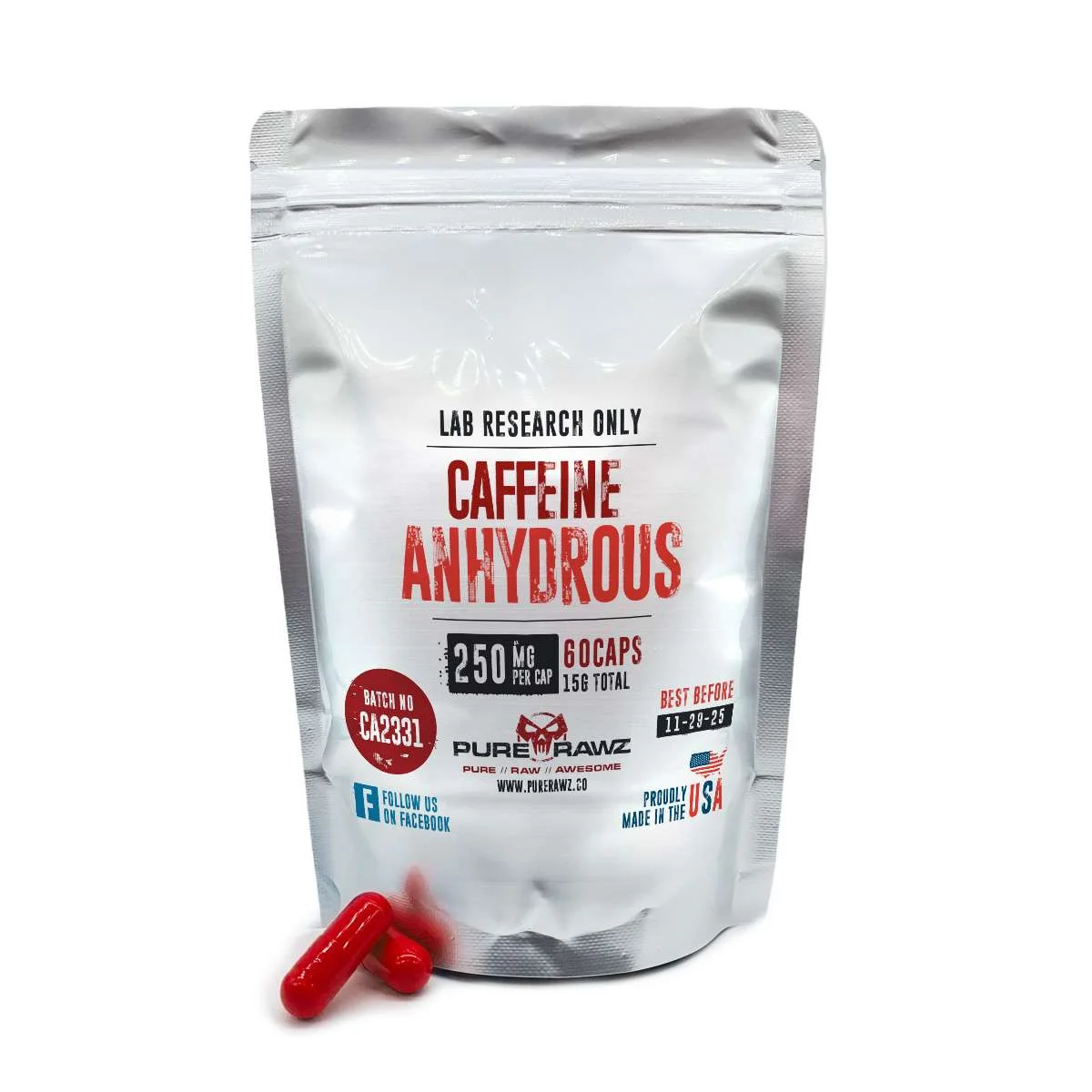
Caffeine Anhydrous

€12
 3 sold in last 15 hours
Buy Caffeine Anhydrous online | Caffeine Anhydrous for sale
Caffeine anhydrous is a methylxanthine alkaloid. It is chemically identical to naturally occurring caffeine. It has the formula C8H10N4O2 and a molecular weight of 194.19 g/mol. Pure caffeine is a white powder. Structurally, it is related to purines.
Chemical and Molecular Properties
| Caffeine anhydrous | |
| PubChem CID | 2519 |
| Molecular Formula | C8H10N4O2 |
| Molecular Weight | 194.19 g/mol |
| Synonyms | 1,3,7-Trimethylxanthine; Guaranine; Anhydrous Caffeine |
| IUPAC | 1,3,7-Trimethylpurine-2,6-dione |
| CAS | 58-08-2 |
| Labeling | Laboratory and research use only |
| Chemical Structure Depiction |  |
| Purity | ≥98% |
| Classification | Methylxanthine alkaloid |
| Storage Temperature | Store in a cool, dry place, protected from light |
| Solubility | Soluble in water, ethanol, and dimethyl sulfoxide (DMSO) |
| Safety | For laboratory and research use only. Follow standard chemical handling procedures. Not intended for human or veterinary use. Use personal protective equipment (PPE). |
Mechanism of Caffeine Anhydrous
Caffeine acts as a competitive antagonist of adenosine receptors. By binding to these receptors, it prevents adenosine from attaching and sending its normal signals. Laboratory studies show that this interference can change how cells respond to their environment.
Caffeine can cross cell membranes and interact with signaling pathways inside neurons. It can affect the activity of enzymes, such as phosphodiesterases, which control the levels of signaling molecules called cyclic AMP. Changes in cyclic AMP can influence how ion channels open and close, affecting the movement of ions like calcium and potassium across membranes.
Researchers also observe that caffeine can modify the release of neurotransmitters in cell cultures and isolated tissue models. It may influence networks of neurons by altering the strength and timing of signals between cells. Laboratory experiments show that caffeine can also impact receptor density and receptor sensitivity over time in controlled settings.
Because of these effects, caffeine is widely used in experimental research to study receptor interactions, intracellular signaling, and cellular communication. Its precise molecular mechanisms are still under investigation, making it a useful tool for exploring neuronal signaling pathways in laboratory systems.
Research Applications
Researchers use caffeine to study cellular signaling pathways in controlled laboratory models. Studies examine how adenosine receptor activity affects ion flow, enzyme activity, and neurotransmitter release. Experiments often use cell cultures, isolated tissues, or membrane systems to investigate biochemical and molecular interactions.
Why Choose PureRawz for Caffeine Anhydrous?
Buy Caffeine Anhydrous for laboratory research use from our online shop. At Purerawz, we provide high-quality reference materials. Each research compound comes with a Certificate of Analysis for verification of purity and concentration.
Note:
Caffeine Anhydrous is an investigational compound currently undergoing clinical evaluation and has not been established as safe or effective for any therapeutic use
Disclaimer
This information is for educational purposes only and not medical advice. Products are for research use only. Research must follow IRB or IACUC guidelines. Verify information independently before purchasing. By ordering, you agree to our Terms and Conditions.
ATTENTION: All our products are for LABORATORY AND RESEARCH PURPOSES ONLY, not for veterinary or human use
| Form | Capsules |
|---|---|
| Strength | 250mg per capsule/60ct/15g |









Reviews
There are no reviews yet.